Sunday, July 25, 2010

Bacio finishes 6th place out of 37 boats at the Melges 20 Gold Cup in Malcesine, Lake Garda

Together with the owner, Michael Kiss from Holland Michigan, Alain Stettler and I represented the USA at the unofficial World Championships of the Melges 20 class.

A brand new Melges 20 (Hull #190) was waiting on us in Malcesine on Monday morning and my good friend Alain Stettler and I spent most of the day putting our sweet little new toy together. (Kudos go out to Federico and his team at Melges Europe for excellent service and always lending a hand if something wasn’t quite as it should.) After some more boat work and two days of practice we started racing on Thursday.
At Charleston Race Week this year we won the Melges 20 event, so the expectations from owner Michael Kiss were understandably high! But looking at the line-up at this event I knew it was going to be WAY harder. First of all we had all of the top Italian teams and they have been sailing these boats hard, REALLY hard and are way ahead of everyone else in terms of boat handling and tuning. Secondly, the tacticians and crews were more or less the crema de la crema in Italy and internationally. Names like Gabrio Zandono, Roberto Benematti, Matteo Ivaldi, Flavio Favini, Nathan Wilmot, Juan de la Fuente, Branko Brzkin, Chicco Fonda were starring down at me… Hmmm, this was going to be interesting and challenging to say the least.
A 6th place in the first race put us on the right track but our hopes for a top finish evaporated when our bow sprit unexpectedly broke in the second race and we limped into the finish in 23rd. To make things worse the fleet sailed another race and we’d have to score a DNC. Arrghhh....

Again Federico and his Melges Europe team pulled through and the next morning we magically had another bowsprit installed when we arrived at the boat. Which other class provides that kind of service, hellloooo!!!
For the rest of the regatta we now had to play it safe as we were already counting a 23rd and were using the DNC as our discard. We sailed a good series of single digit finishes which put us in 6th place overall in the end. Full results can be found here.
Oh and did I mention that almost all races were sailed in 15 - 20 knots and sunshine?

For our team this was mainly a good event to learn more about the tuning and for Michael to get more comfortable in boat-on-boat situations and managing tight lanes. We did a lot of spy work on the top Italian teams and were on par with them at the end of the regatta. So overall this has been an excellent opportunity for us to improve our skills and hopefully get a little jump on the US Fleet at the up coming Nationals in Holland, MI in about a months time.

What were the highlights of this regatta?
  • Excellent service
  • Spectacular regatta venue and race management
  • Great food
  • Outstanding crew (Alain)
  • Very focused and trusting driver (Michael)
  • A few good tactical calls
  • Improvements in upwind speed
  • Solid downwind speed
  • Morning and evening bike rides along Lake Garda

What were the down sides of this regatta?
  • Broken bow sprit
  • It actually rained once
  • Traffic through Torbole
Here some more pics by Carlo Borlenghi, Renato Tebaldi, Meredith Block and Fabrizio Prandini
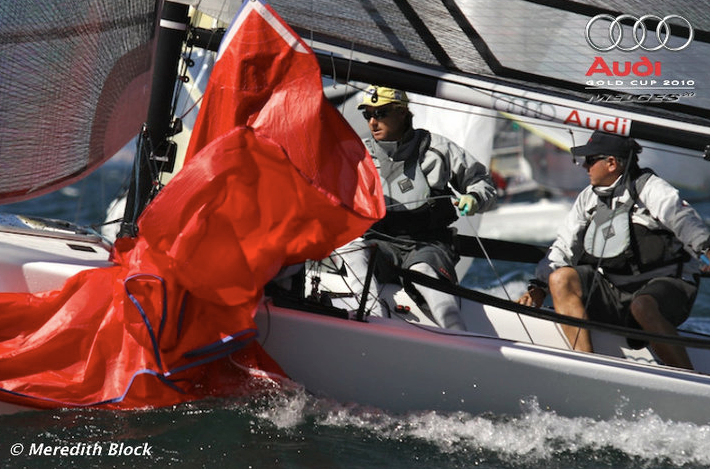
Bacio at leeward gate, Alain fighting with the kite
Bacio blasting downwind
All Ladies team "Troublemakers" showing how it is done!
Alain and Michael taming the beast, where's Chris?
Michael getting us around the leeward mark safely

For more pics and video by Mr Clean visit the Melges Europe Facebook page.

So far sailing in this class has been a blast and I can't wait to get back on the Melges 20!

Chris out

Monday, July 12, 2010

Melges 24 Volvo Cup in Torbole, Lake Garda

Last week I had the great opportunity to sail Melges 24 with my "old" Match Racing Team and the addition of Felix Kaiser on one of the most beautiful sailing venues in the World, Lake Garda. We were going to sail the Swiss EFG Bank Melges 24, Hull nr 336. Lake Garda didn't disappoint and we had 12 races sailed in 12-20 knots of "Ora" and sunshine, every day.
My team included Alain Stettler (an old high school buddy of mine) our trimmer, Patrick Zaugg our tactician, Pascal Alder our bow man and Felix Kaiser doing Middle.
Before the race even started we had a bit of drama. The racing was going to start on Thursday and somehow we thought it started on Friday! As Pascal and Felix were only arriving on Thursday evening we needed to find some replacement crew. Lucky enough for us, Dave Hudson (a good friend of our family) from Capetown was in town practicing for the Laser SB3 Worlds and we "borrowed" Marlon and Roscoe from his team for the first day.
Sailing in Torbole in the Melges 24 is really intense as usually you have to work the left side of the course, up the cliffs and then find the right moment to exit on port.
Having a fleet of 60 boats tacking up the shore provides for some interesting crossing situations and often some boats end up having to be taken out of the water at the end of the day. Not having practiced together at all we started a bit shaky and after two days were laying in eight place, knowing why the Italians are dominating this class. It's impressive how professional this guys run their campaigns! But in the mean time we had also managed to snitch a bullet from them and were drawing first blood....

The third day saw us sailing a consistent series with all top 8 finishes which solidified our position in the top eight, laying only ten points out of third. With three races to go, a podium finish was definitely still in reach. In the first race on the last day another mid-line start with a good transit line gave us a great lane to the cliffs and we were able to squeeze around the windward mark in 2nd. A couple of well placed gybes saw us take the lead and eventually the bullet. Nice way to start the last day of racing!

Things were looking good with 2 minutes to go before the start of the next race, but I was a bit trigger happy and jumped the gun. "OCS Bow number 99" came over the radio and we had to turn back to restart. After having some serious issues with connecting the dots on the first upwind, we eventually rallied back to 16th. Unfortunately the race was started under the Z-flag rule which meant that 20% of the fleet was added to our score (becoming our throw-out). The race committee signaled the warning signal to the last race 2 minutes before 14h00, the last possible time to do so and we were off to another race. We actually played the middle this time and rounded the mark in 4th. Ricardo Simoneschi on "Audi" and our team went back and forth for third place. We eventually got him on the last gybe to the finish, when "simo-gybed" with him and then rolled him. Needlessly to say the whole team was pleased with this last maneuver! Our finishes were: 7, 23, 4, 11, 1, 18, 6, 8, 5, 1, (16) and 3, putting us in 6th overall.
It was really nice to be sailing with some friends, bombing around lake Garda during the day, eating great food in the evening and closing the "Wind's Bar" at night. I guess this qualifies as a true active holiday in my book!
My thanks go out to all my team mates and to EFG Bank for providing us with a fine Melges 24 for this regatta.
More pictures to the regatta can be found here and the results can be found here.
Photo credits by Pierrick Contin

Thursday, June 17, 2010

The Attitude of Winning: Embracing the Challenge

"You gotta be out of your freaking mind!" was the response I got from one of my best sailing buddies when I explained to him in early 2006 that Tim and I were considering campaigning in the 49er for the 2008 Olympic Games. "Morgan and Pete (one of the other US 49er teams) are currently almost dominating the class and you guys want to go up against them? You haven't even ever crewed in the 49er!"
I understood his reasoning but at the same time also realized that with that kind of an attitude you were never going to win a Gold Medal.

In today's short article I would like to dig into the most important factor when it comes to winning or losing: The Attitude of Winning. There are many parts that make up this attitude and one of them is the way we embrace challenges. It's something we are faced with every day, sometimes just on a small scale and sometimes it can be life changing challenges that must be conquered.

Some people think of challenges as mountains that have to be climbed. They see only the small crevices and steep walls, the difficulty of making it on to the next ledge.

I prefer thinking about the view we will enjoy when we make it to the top. The only way to truly master a challenge starts off by embracing it. You must be grateful to have been put into a position of facing the challenge.
That brings me back to the beginning of the article. Yes, campaigning for the Olympic Games is one of the biggest challenges you can commit to. Doing it whilst having to beat other great teams in order to actually go there makes your life even more difficult! And that is the point. The view from the top of that mountain is only as good as the challenges you must overcome in order to get there.

So the next time you're faced with steep competition at your next major regatta, embrace the challenge. Be grateful of having so many great competitors to sail against. As you're coming into that leeward gate with ten other boats at the same time, enjoy having the opportunity to show what you're made of.
Instead of being afraid of getting you're ass kicked, be grateful for the opening that lets you improve your skills.


Chris out

Sunday, May 16, 2010

Gears and Transmissions

Dear readers
I'm feeling pretty lucky today so I have decided on writing this "delicate" and slightly weird article. Since I'm expecting to lose approximately half of the readers half way into the article I will start off by telling you what value it will bring if you persevere all the way until the end:
  • If you are a skipper or someone who is frequently in the position of putting new teams together, this article will give you new overall perspective on this issue.
  • If you are a Pro or Amateur Sailor it will help you realize what it takes to integrate into a team and hopefully you will question some of your current practices. (Never a bad thing to take a hard look at yourself, right?)
Here it goes. Business School has taught me that its very powerful to utilize analogies when explaining difficult concepts and that's what I will do here.
I will begin by explaining you the basic concepts of gears and a gearbox. (Again, please bear with me!)
 Picture from wikipedia, a five-speed gear box
Note the different sizes and tooth shapes of the gears mounted on the shafts
  • The purpose of a gearbox is to transmit power from a power source into something else, often allowing for a change of direction and different gear ratios
  • The efficiency of a transmission is defined by the quotient of the power at the output and the power at the input. (The more losses you have, the worse the efficiency will be). In an ideal world you would want to have 100% efficiency....
  • Gears come in many different sizes and tooth shapes. These shapes include straight cut, helical, double helical, bevel, hypoid crown, worm etc. Check out the wikipedia page on gears if you really want to dig into details...
So what makes it a good gearbox? A good gearbox:
  • Performs under the most adverse conditions (e.g. even if one gear somehow stops working), snow, sun, low and hot temps etc.
  • Has the appropriate gear ratios (amount of forward / reverse gears and ratios etc.)
  • Has low maintenance requirements (may be even self lubricating)
  • Has maximum possible efficiency
  • Is user friendly. Meaning that it is relatively non partisan to different kind of operators (the mechanism that shifts between the various gears
  • Does all the above at the lowest possible cost
In order for a gearbox to function properly:
  • It has to be designed to the correct specifications
  • All the gears need to have the appropriate size and tooth shape (straight cut won't work with helical, duh...)
  • Needs to be lubricated properly (oil levels!!!)
  • The shafts on which the gears are mounted need to be strong enough and properly aligned, otherwise you will have wear and tear on your gears and thus low efficiency.

So this is the point where I believe that anyone that doesn't subscribe to Popular Mechanics, will have closed this window and is updating their Facebook page with a note telling all their friends that I have completely lost it.

So how does this relate to sailing? Well, most of you have probably figured this out by now (and otherwise you're probably not the sharpest gear in the gearbox!)

I like to compare team members on a sailing team to gears in a gearbox (gearbox being the team).
Designing a new gearbox takes more than experience. Actually often it is closer to performing a long lost craftsmanship than anything else. Some owners/team managers believe that all you have to do is go out and get the best sailors on your boat and they will have the best possible gearbox available and win the regatta. Too many regattas have proved that this is the wrong approach...

I would like to suggest the following approach:
  • First of all determine the specifications of your gearbox. What is it supposed to do? How many gears? Which are the most important gears? How long does it have to last? The list goes on.
  • What are the resources at your disposal and compare that to the available gears on the market.
  • Analyze each gear on their compatibility with the other gears and evaluate what else they can contribute to the gearbox. (Some gears are known to also give back rubs and bake chocolate chip cookies for all the other gears. Such attributes help with keeping the gearbox nicely lubricated, hi Sarah C. !)
  • According to your budget and time constraints, build your gearbox and allow it to adjust to each gear (practice time). You can for example also bring in a coach to help you align the shafts (less wear and tear), help modify the tooth shapes and make your gearbox more efficient!
  • Once things are moving smoothly make sure to check the oil level periodically. (I have heard that nice team dinners or inviting your gearbox to a ski weekend in Park City works wonders in that area.)
And what does this mean to you as a gear within the gearbox?

Figure out what kind of a gear you are, so you know where you can add the most value. You don't want to end up somewhere on the shaft, having to work on a task that you're not good at. You won't be happy, and the rest of the gearbox won't be happy. Everybody on the shaft gets shafted, pun intended.
Whenever necessary and within your capacity you must adapt to the position you have been designed to do. This can also mean that you will have to change the shape of your gear teeth in order let things work smoothly. Can you do that?

Pro-Sailors like to gloat about themselves how they can just fit into any team and perform at the highest level. Unfortunately I have often experienced the opposite. Quite a few are prima donnas, need a lot of lube and usually have everyone else adapt to their tooth shape. In the process losing valuable other gear ratios and minimizing efficiency.
Amateur sailors on the other hand sometimes think they have the necessary gear ratios and strength and just can't deliver when the pressure is on.

What kind of a gear truly are you?

Hopefully this article has achieved its goal of allowing you to approach the way you put teams together in a new way and has you second-guessing how you as a gear could help the gearbox work more efficiently.

Chris out

P.S. Comments?

Sunday, May 9, 2010

You hide, you lose... Getting the most out of sparring partnerships

In our preparation for the forecasted light air conditions in China, Tim and I decided to hold two training camps in San Diego and Long Beach. We invited the Canadian and the Ukrainian Olympic representatives to join us.
 Rodion and George with some seals, picture taken in San Diego. They were super excited about these seals and made me take hundreds of pics of them...
Well, one of the great attributes about San Diego (apart from pretty consistent light air conditions) is the high concentration of truly remarkable sailors. I was looking for some advice for our upcoming partnerships and I found myself talking to Vince Brun and David Hughes at North Sails in Point Loma. In regards to how we should handle information sharing with our sparring partners (which would eventually be our competition at the Olympic Games), Vince's advice was simple. In his usual Brazilian accent he said: "You hide, you lose."

The most precious resource you have while campaigning is time. It's not money or energy, it's time and thus we must use it as efficiently as possible. It doesn't matter if you're in it for an Olympic Medal or preparing for a National Championship, if you need to fast track your learning curve then one of the best ways doing this is by working together with other teams. The benefits of working with sparring partners are manifold. Apart from having a speed benchmark, you get to share laughs and hard times, channel your competitive spirit on them (instead of yourself or your team mates) and sometimes it's just about sharing a beer with someone else than your skipper.

So how do you get the most out of a sparring partnership? Who do you partner with?
  • In an ideal world you find partners, which are faster/better than you in the conditions you're trying to improve in, but won't beat you in the regatta. You're looking for teams, which are practice kings, but can't deliver when the pressure is on.
  • Next on the list is reliability. A team, which always shows up on time and is organized is way more valuable than hotshots which grace you with their appearance when it fits their schedule.
  • All of this goes down the drain if you can't generate trust. Going the extra mile to accommodate your partners will most likely result in reciprocal actions and you will build a relationship that will provide much more than just a benchmark.
  • And obviously its an added plus if you like hanging out with them as well
Apart from working with the Ukrainians and the Canadians, one of our most memorable and fulfilling partnerships was with the German 49er team, Jan and Hannes Peckolt. They were highly dedicated, reliable and very German (and I don't mean that in any negative way). Together we spent countless hours on the water making each other faster, pushing each other when one team was ready to throw the towel in, sharing mast bend measurements and tuning philosophies. Jan and Hannes sailed a great Olympic Regatta and their efforts were rewarded with a bronze medal. I'm proud to have been part of the process in getting them there.
Chris enjoying a cappucino in the German team container during our training in Qingdao. Their container was amazing....

And that's what campaigning for the Olympic Games ultimately is. It's about working on experiences, goals, challenges and partnerships that you can be proud of for a life time, most likely more proud of than winning a Gold Medal...
So my advice to all of you who are seeking to work with sparring partners is to build a partnership that you can be proud of, no matter what the scoreboard ends up being. As Vince would say: "You share, you win!"

Sunday, May 2, 2010

Elvstroem Zellerbach, 2nd day of racing

Another beautiful day in San Francisco... We're about to board our Southwest flight so this one is going to be quick.

We sailed another three races today in a pretty well established westerly. The racing was tight in the front and we had some really good tacking duels up the shore line. We sailed very consistent but not quite good enough. In the end we lost the tie breaker with Max and David to finish third. The regatta was won by Screve/Moody, which seemed very comfortable once the breeze came up.
The first race of the day was won  by Kristen and Charlie and that was awesome!

For the last race the breeze was pumping and only Screve/Moody, Max/David, the Nielsens and our team were duking it out at the front of the pack. It was close racing and overall a very enjoyable weekend.

Our thanks go out to St Francis Yacht Club for putting up a great regatta.
Full results can be found here.
Chris out!

Saturday, May 1, 2010

Elvstroem Zellerbach, 1st day of racing

JP and I are back together in the 29er, racing in the Elvstroem Zellerbach in San Francisco. The turn-out is a bit disappointing with only 10 boats on the starting line, but we do have some really good teams present.
We have Charlie McKee crewing for Kristen Lane from team Brickhouse (her 29er is called the "Brick Skiff"), Antoine Screve/ James Moody (the US team that will be representing at the ISAF junior worlds this year in Istanbul Turkey), Max Fraser/David (finished 5th at the worlds in the Bahamas) and few other talented juniors.
This is how it looked like this morning:
It was pretty low tide and we were going to race in the flood the whole day. Everyone who has sailed at St Francis Yacht Club knows that the current place a huge role. Especially in the lighter breeze. In a westerly breeze everybody heads immediately for the shore in order to get out of the adverse current. And that's what we did in the first race. We led for almost the whole first upwind, just to get caught by Max and David that kept working the shore even more than we did! Luckily we had pretty good downwind speed and were able to recapture the lead and win the first race.

Then finally the wind started to pick up a bit and continuously did so until the 4th and last race of the day when we started seeing some good puffs in the 18 knots range. But with the incoming tide it wasn't really a problem to handle it as the waves stayed fairly small.
Team Screve/Moody really lit it up with decent boat speed, but even better upwind tactics. Twice they pulled away from us by staying longer on the outside and picking a good right shift to come back to the shore. Well done boys! Our team did o.k. as well, ending the day on a 1st, two 2nds and a 3rd. Full Results can be found here.

And this is how it looked like when we came back in, just ridiculously amazing, isn't it?
JP and I are looking forward to a couple of more races tomorrow. Oh, and did I mention that JP pulled off four absolutely amazing starts? Wolf style baby....
For people who would like to watch the racing live you should try the St Francis Webcam that allows you to zoom in and turn the camera. Racing will start late because we have to wait for the Escape from Alcatraz Triathlon to get under way.
The Triathletes swim from Alcatraz to Crissy Field (right next to St Francis Yacht Club) and then get on their bikes.
Chris out